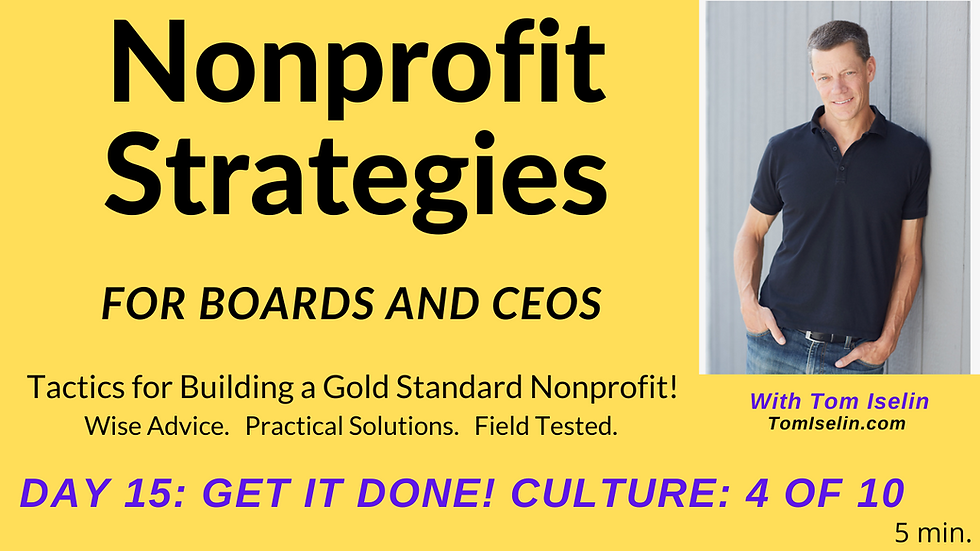
Nonprofit Culture - Definition and Overview
Updated: Dec 17, 2025

Nonprofit Culture - Definition and Overview
Today, I’m kicking off a few blogs on how to create a true “Get It Done!” culture. That’s right—culture.
Because here’s the reality: if you bring together a group of high-quality people who care only about their own individual passions, and there is no collective passion for your nonprofit, you’ll end up with talented people working in silos—with no unified effort to fulfill the mission.
If you want to effectively fulfill your mission, you must create a culture that unifies everyone.
This video serves as an overview of a ten-part series designed to help you understand what culture really is—and how to intentionally build a better one.
As you may recall, I began Boot Camp with a series on how to bring on and retain high-quality people to build a high-performance nonprofit. After that, I launched a series on Authentic Passion, where I explained how to transform an environment of lip-service passion into one of authentic passion—and why that transformation is essential to mission success.
Today, I’m launching a new series focused on how to create a “Get It Done!” culture.
Why Culture Matters More Than Talent Alone
High-quality people are important. Authentic passion matters. But without a unifying culture, even the best people struggle to work together effectively.
Without culture, you get:
Siloed effort
Conflicting priorities
Misaligned energy
Little collective momentum
If you want your nonprofit to truly move forward, culture must unite everyone around shared beliefs, behaviors, and expectations.
The Championship Team Analogy
Have you ever played on a championship team?
Maybe it was soccer, tennis, gymnastics, debate, band, theater, or another competitive group. Whatever the activity, winning teams share common traits:
Everyone has a role
Every role matters
People train individually and collectively
The team works toward shared goals
Championship teams are driven by authentic passion and inspired by leaders who balance high expectations with compassion, guidance, praise, and accountability.
Winning creates momentum. Momentum creates belief. And belief fuels even greater effort.
Nonprofits Are No Different Than Teams
Working for a nonprofit is a lot like being on a sports team.
Each nonprofit sector is its own “league,” with unique rules, language, and expectations. Nonprofits operate locally, regionally, nationally, and globally—but no matter the league, they’re all made up of people who believe their participation will make a difference.
Some teams win because they have a star player. Others win because they have a great coach. Some have both—and still fail.
Why?
Because winning consistently requires more than talent and leadership. It requires culture.
Star Players Don’t Win Without Culture
The same holds true in the nonprofit world.
Some organizations are blessed with:
A charismatic founder
An influential board chair
A gifted fundraiser
An exceptional program director
These people matter. They’re assets. But unless there is a strong, unifying culture, even star players won’t lead a nonprofit to long-term success.
Talent without culture rarely wins championships.
Mission, Vision, and Culture: Know the Difference
Here’s the distinction every nonprofit must understand:
Your mission tells people what you do
Your vision tells people where you’re going
Your culture tells people who you are
Culture shows people what you stand for.Culture reveals what you believe.Culture determines how people behave when no one is watching.
A well-defined culture is the bedrock of a winning nonprofit. It’s the ethos that binds the hearts, minds, and actions of everyone connected to the organization.
Why So Many Nonprofits Struggle
Here’s the irony: very few nonprofits intentionally define their culture.
That’s one reason so many organizations stumble, stall, and struggle as they grow. Without a clear culture, nonprofits lose alignment, energy, and direction—and never make it to the championship round.
So What Is Culture, Really?
Culture is the outward expression of how and why a nonprofit operates.
It includes:
Moral and ethical standards
Guiding beliefs and values
Repeated behaviors
Cherished customs
Unspoken understandings
Shared interests
Distinguishing habits and style
In simpler terms, culture answers fundamental questions like:
What does it mean to be part of this board?
What does it mean to be part of this staff?
What does it mean to be part of this organization?
Culture also answers:
How do we do things around here?
How should we behave?
What type of environment do we want to create?
A Culture Reality Check
If I dropped into one of your board meetings, what would I see?
Excellence or mediocrity?
Collaboration or conflict?
Organization or chaos?
A “do something” mindset—or a “do as little as possible” attitude?
The answers to those questions reveal your culture—whether you’ve defined it or not.
Takeaways
If you want a nonprofit that consistently performs at a high level:
Talent alone is not enough
Authentic passion must be unified
Culture must be intentional
Winning requires shared beliefs and behaviors
Culture is the glue that holds everything together.
Summary
A “Get It Done!” culture unifies people, channels passion, and drives results. Without it, even the best nonprofits struggle to reach their full potential.
This series will walk you through how to define, build, and sustain a culture that helps your nonprofit win—season after season.
Tom Iselin
“One of America’s Best Board Retreat and Strategic Planning Facilitators”
Additional Resources:
Articles
Tom's Books, Podcasts, and YouTube Channel
About the Author
Tom Iselin is recognized as one of America’s leading authorities on high-performance nonprofits. He has built nine sector-leading nonprofits and two software companies, written six books, sits on multiple boards, and has been rated one of America’s Best Board Retreat and Strategic Planning Facilitators. His work on nonprofit strategy, board leadership, and culture has been featured on CNN, Nightline, and in Newsweek.
Tom is the president of First Things First, a firm specializing in board retreats, strategic planning services, fundraising strategy, and executive coaching for nonprofit CEOs.
Board Retreats & Strategic Planning
If you’re looking for a board retreat facilitator or strategic planning facilitator who has been in the trenches and understands real-world nonprofit challenges, Tom can help your board gain clarity, build alignment, and create an actionable plan that improves performance and impact. His sessions propel organizations to the next level of performance and impact . . . and they're fun!
Board Retreats and Strategic Planning Services:
858.888.2278